

Snake Plant
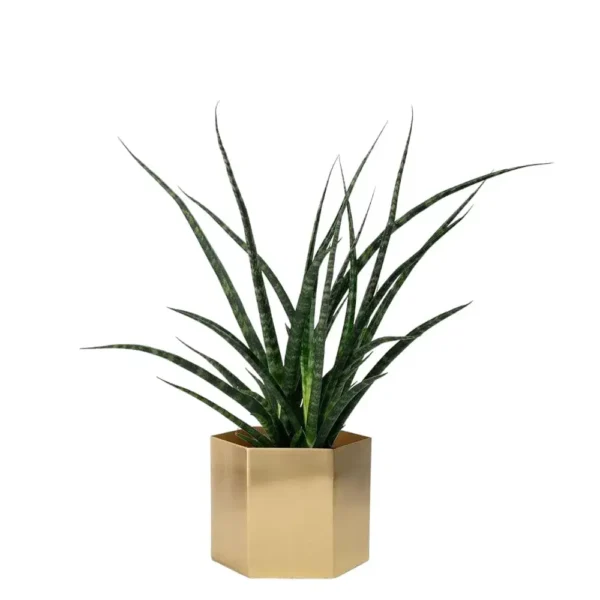


A snake could be a scary and harmful addition to your family, but a snake plant offers the exact opposite.
When it comes to low-maintenance houseplants that offer both beauty and benefits, Snake Plants can be a great choice. Known for their upright, sword-like leaves and air-purifying properties, these plants are finding inclusion in the modern Indian homes and offices. One of the biggest reasons Snake Plants are so popular in India is their exceptional adaptability. But there are many other reasons also!
Snake Plants are popular in Indian homes because of their exceptional adaptability and low maintenance. Their low water requirement makes them ideal if you are someone who is lethargic or too busy to water plants regularly—you can be worry-free with a Snake Plant around.
They also survive in low light, which is great since not everyone in India has the luxury of a sun-facing home or apartment. Luckily, Snake Plants not only survive without sunlight but also thrive in such conditions. Another major reason for their demand is that they improve the air quality. So many problems and diseases can be tackled if polluted air can be kept away.
While solving air pollution on a root level is still a distant dream in India, Snake Plants offer a natural and reliable solution. Lastly, their decor benefit adds to their charm, as their appealing upright leaves blend well with existing interiors.
Health Benefits: More Than Just a Pretty Plant
Snake Plants help in a number of ways, making them more than just a decorative plant. Firstly, they minimize pollution in the air, acting as natural air purifiers.
Secondly, they serve as wellness boosters. You would be surprised to know that even NASA has highlighted their positive impact on indoor air in its Clean Air Study.
And that’s not all! Snake Plants also release oxygen at night, helping ensure you get enough oxygen for high-quality, rejuvenative sleep. In addition to that, they reduce allergens by trapping dust particles, which can be especially helpful in dusty or polluted environments.
They also help ease breathing issues, making them a valuable plant in homes located in cities with poor air quality. Moreover, Snake Plants increase the humidity in the air—something particularly useful in dry, AC-heavy rooms. All these benefits make them a practical and health-conscious choice for Indian households.
Significance of Snake Plants in a cultural and spiritual aspect
You would be surprised to know that Snake Plants are believed to bring positive energy as per Vastu Shastra.
Many Indian families are advised to keep Snake Plants near entrances or in the southeast corner of the house because they fend off negative and low vibration energies.
Due to these reasons, many people give snake plants as gifts during housewarming ceremonies and festivals.
Common Myths About Snake Plants – Busted!
You would be surprised that there are many myths about Snake Plants despite being so popular.
You would be surprised to know that despite their popularity, many myths still surround Snake Plants. One common belief is that they are toxic and should not be kept at home. This is only partially true. While the plant does contain saponins and is mildly toxic to pets if ingested in large quantities, it is not harmful when simply placed indoors. As long as the plant is kept out of reach of curious cats or dogs, it poses no danger and can be safely enjoyed in any home.
Another widespread misconception is that Snake Plants only grow in outdoor conditions. In reality, they are one of the best indoor plants available. They don’t require sunlight and can even thrive without it, making them ideal for Indian households where access to direct sunlight is often limited. Their resilience and low-light tolerance make them a practical and aesthetic addition to urban living spaces.
Some people also believe that Snake Plants bring bad luck, but this couldn’t be further from the truth. In fact, according to Vastu Shastra, Snake Plants are thought to bring positive energy and act as natural protectors against negative vibrations.
Many families in India place them near entrances or in the southeast corner of their homes to ward off negativity. Far from being unlucky, they are often gifted during housewarmings and festivals as symbols of well-being and harmony.
 PEBBLES
 PLANTS GROWTH
 PLANTHING MATERIALS